Dallas & Fort Worth
6605 Colleyville Blvd.
Colleyville, TX 76034
 Call now
(877) 997-4464
Call now
(877) 997-4464
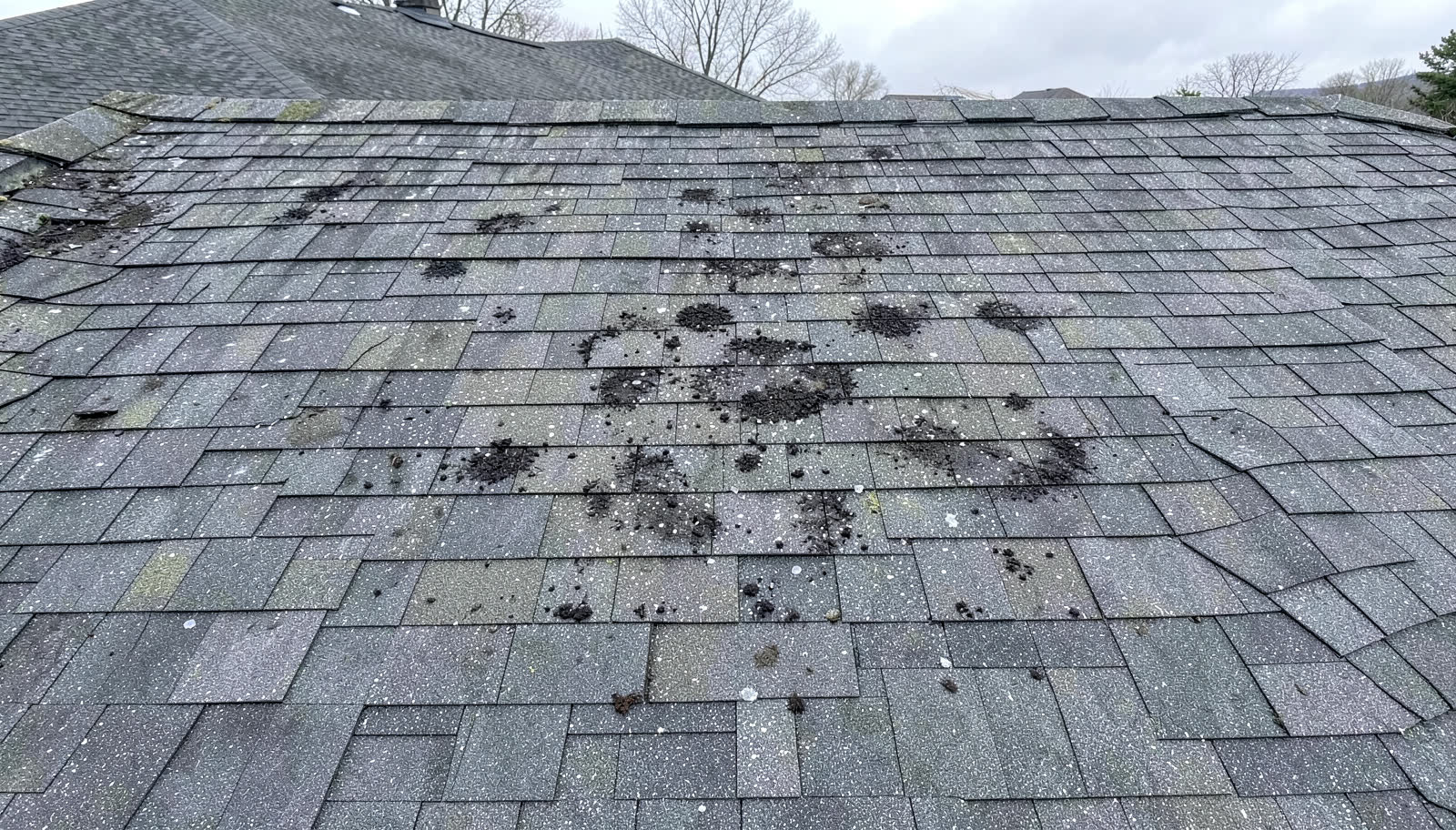
Hail & wind damage — Texas
Texas leads the country in major hail events, year after year. Here's how to tell if your roof was actually damaged, what the claim process really looks like, and what we can and can't legally do for you.
First 48 hours
In this order. The first three cost you nothing and protect you later.
Wet or hail-damaged roofing is genuinely dangerous, and you don't need to be up there to start a claim. Photograph what you can see from the ground and from windows.
Dented gutters, downspouts, window screens, the AC condenser fins, your car, patio furniture. Collateral damage on soft metal is some of the clearest evidence that hail actually fell at your address.
Tarp an active leak and move what's underneath it. Keep receipts for anything you buy — emergency mitigation is usually reimbursable. Hold off on permanent repairs until the damage has been documented.
Knowing whether you actually have damage — and roughly how much — before you pick up the phone puts you in a much better position than filing blind on a maybe.
You file the claim. It's your policy and your call. We'll give you our written documentation to file alongside it.
Careful with that last one: a claim on a roof that turns out to be undamaged can still show up on your claims history. That's why an inspection first is worth the hour.
Self-check
You can check every one of these from the ground or a window. If you spot two or more, it's worth having someone walk the roof.
Not sure what you're looking at? Send us a photo through the chat on this page and we'll tell you straight whether it's worth an inspection.
Free inspection
We'll walk the roof, photograph what's there, and tell you honestly whether you have a claim worth filing.
The claim process
Where we fit, and — just as importantly — where we don't.
Our estimator walks the roof, photographs the damage, measures the roof, and writes a detailed line-item estimate of what it takes to repair it properly.
You own the policy, so you make the call and you're the one on the claim. We hand you our documentation and estimate to submit with it.
You're welcome to ask us to be on the property during that inspection, schedule permitting, so we can point out what we documented and answer technical questions about the roof itself.
That's their itemized estimate of the damage and what they'll pay. Compare it against ours.
Rotted decking, code-required ice and water shield, drip edge, ridge venting — things that only show up once the roof is opened. We write it up with photos and give it to you to send to your carrier.
Once you decide to move forward, we schedule the work and install to manufacturer spec so the material warranty stays valid.
Straight talk about the limits: under Texas law, only a licensed public adjuster may negotiate or adjust a claim on your behalf, and a roofing contractor cannot be both your roofer and your adjuster on the same property. So we document, we estimate, and we explain — you file, you decide, and you communicate with your carrier. Any roofer who offers to "handle the whole claim for you" is describing something they're not allowed to do.
The honest answer
Yes. And be careful with anyone who tells you otherwise.
Texas law requires a person insured under a property policy to pay the deductible on a first-party claim, and it is illegal for a contractor to waive it, absorb it, rebate it, or help you avoid paying it — including by padding the estimate to cover it. That's not a technicality: the Texas Department of Insurance says contractors who do it can be fined or jailed, and your insurer can ask you to prove you actually paid it. So a roofer who offers to "eat your deductible," "work it into the numbers," or "waive it if you sign tonight" is proposing something illegal — and telling you exactly how they'll behave once they're on your roof.
If a contractor offers to waive your deductible, the Texas Department of Insurance recommends you tell your insurance company and report it to the Texas Attorney General's consumer protection hotline at (800) 621-0508.
Requirement to pay: Texas Insurance Code ch. 707 (added by HB 2102, 2019). Guidance above is from the Texas Department of Insurance, "Is it OK for a contractor to waive my deductible?" This is a plain-language summary, not legal advice — read the statute or ask your own advisor before relying on it.
Choosing a roofer
Out-of-state crews follow storms into Texas, sell fast, and are gone before the first warranty call. Here's how to check anyone who shows up — including us.
| Storm chaser | An established local contractor | |
|---|---|---|
| Address | A truck, a motel, or an out-of-state PO box | A physical office you can drive to |
| Phone | A cell number that changes | A published local line for that metro |
| History | Formed this year, or a name you can't find | A business and a domain with years behind them |
| Pressure | "Sign today or the price goes up" | An estimate that's still good next week |
| Deductible | Offers to waive or absorb it | Tells you the law and charges it |
| Warranty | A promise from someone leaving the state | A company still here to answer the phone |
| Payment | Large cash deposit up front | Normal draw schedule, documented |
Ask any roofer — us included — for their physical address, proof of insurance, and a couple of local references you can actually call. Anyone offended by those questions has answered them.
Decoder
Neutral definitions so the paperwork stops being intimidating. For how any of these apply to your policy, your carrier or a licensed public adjuster is the right person to ask.
Your insurer's itemized estimate of the damage and what they intend to pay for it. It's the document to compare against your contractor's estimate.
The value of the damaged property after depreciation for age and wear. Many policies pay ACV first and hold back the rest.
What it costs to replace the damaged property today, without deducting for age. Whether you get RCV depends on your policy.
The difference between ACV and RCV that some policies release after the work is actually completed and invoiced. Ask your carrier what triggers its release.
An additional request to the carrier for work or materials that weren't in the original scope — commonly damaged decking found after tear-off, or code-required items.
Many Texas policies carry a separate, often percentage-based deductible for wind and hail that's higher than the all-peril deductible. Check your declarations page.
An endorsement on some policies that excludes hail damage which affects appearance but not function — most often on metal roofs. Worth knowing before a storm, not after.
A separately licensed professional who may negotiate a claim on your behalf for a fee. In Texas your roofing contractor may not also act as your public adjuster on the same property.
Common questions
Policies set their own deadlines and Texas law sets outside limits, so the practical answer is: sooner is dramatically better. Evidence degrades, and the longer you wait the easier it is for anyone to argue the damage came from a different storm. Check your policy's notice requirement and call your carrier.
That's between you and your carrier, and it's a fair question to ask them directly before you file. It's also why we inspect first — so you're not filing a claim on a roof that turns out to be fine.
Maybe. Hail falls in narrow, uneven swaths, and it's genuinely common for one side of a street to be hit and the other side to be fine. It's a good reason to get inspected, not a guarantee of damage.
Call the office nearest you and say it's an active leak. The immediate goal is to stop water getting into the structure — that's tarping and mitigation — and the permanent repair follows once it's dry and documented.
Where our schedule allows, yes — and it's usually a good idea. We can walk the roof with them and point out what we documented. What we can't do is negotiate the claim on your behalf — that's licensed public adjusting, and in Texas your roofer can't do it on the same property.
You have options — asking your carrier to re-inspect, invoking your policy's appraisal clause, or hiring a licensed public adjuster. A denial is also not the end of the roof: if it needs work, we can talk about doing it outside the claim.
Storm response
6605 Colleyville Blvd.
Colleyville, TX 76034
1514 Avenue D
Katy, TX 77493
827 S Interstate 35, Suite A
New Braunfels, TX 78130
Free quote
Tell us what you're seeing and someone from the nearest office will call you back. If you have an active leak, say so — those jump the queue.
 Call now(877) 997-4464